


Since 2019, crypto income in Poland has been taxed in a separate “basket”: you pay 19% on the surplus of revenue over costs and report it on the PIT-38 return. The rules are simpler than they look, but a few details - crypto-to-crypto swaps, costs carried over from previous years and NBP exchange rates - regularly cause trouble. We explain them with examples. The guide applies to Polish tax residents; legal status as of September 2026.
Key points
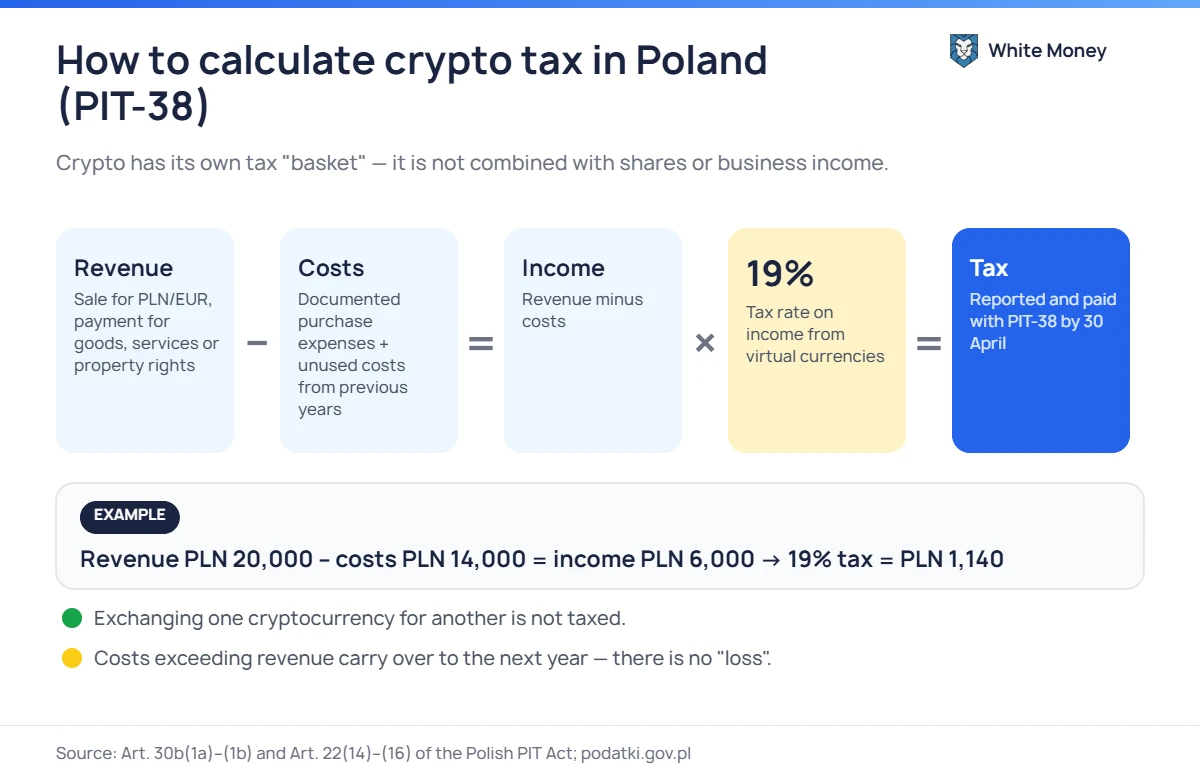
- The tax is 19% of income, i.e. revenue minus documented costs (Art. 30b(1a)-(1b) of the Polish PIT Act).
- Swapping one cryptocurrency for another, e.g. BTC for ETH or USDT, does not create taxable revenue.
- There is no such thing as a crypto loss - excess costs roll over to the next year.
- PIT-38 for 2026 is filed between 15 February and 30 April 2027, even if you only bought crypto that year.
- Since 2026, crypto-asset service providers in the EU collect and pass customer transaction data to tax authorities (DAC8).
1. When crypto revenue arises
The PIT Act treats the disposal of virtual currency as income from capital (Art. 17(1)(11)). The key is the definition of “disposal” in Art. 17(1f): exchanging virtual currency for legal tender, goods, services or property rights other than virtual currency, as well as settling other obligations with virtual currency.
In practice, tax only appears when you “exit” crypto into traditional money or pay for something real with it. As long as you move between tokens, there is no revenue - the Ministry of Finance confirms this in its guidance on podatki.gov.pl.
| Transaction | Taxable revenue? | What to know |
|---|---|---|
| Selling BTC for PLN or EUR | Yes | Revenue is the amount received; foreign currencies are converted at the NBP rate. |
| Paying for goods or services with crypto | Yes | Revenue is the market value of the goods or services. |
| Swapping BTC for ETH or BTC for USDT | No | Tax-neutral; the cost of such a swap is not deductible either (Art. 23(1)(38d)). |
| Buying crypto for PLN or EUR | No | This is a cost - report it on PIT-38 for the year of purchase. |
| Transfer between your own wallets | No | Keep the transaction history (TXID) as proof that ownership did not change. |
What about stablecoins?
USDT and other popular stablecoins generally fall within the definition of virtual currency, so swapping BTC for USDT is tax-neutral. The status of e-money tokens under the EU MiCA Regulation (e.g. USDC, EURC) is less clear: the draft Polish crypto-assets market act would have explicitly treated them as virtual currency for PIT purposes, but as of September 2026 it has not entered into force. For larger amounts, consult an adviser or apply for an individual tax ruling.
2. How to calculate the tax: revenue, costs and the 19% rate
Income is the difference between disposal revenue and the costs defined in Art. 22(14)-(16). You pay 19% tax on that amount. Crypto forms a separate basket: it is not combined with income from shares, derivatives or business activity (Art. 30b(5d)).
Which expenses count as costs
- documented expenses incurred directly to acquire crypto for fiat money, goods or services,
- costs of disposal, including exchange, broker and intermediary fees on sale,
- unused costs from previous years reported on an earlier PIT-38.
Costs do not include, among others, interest on a loan taken to buy crypto, mining hardware or the electricity it uses, or expenses on swapping one cryptocurrency for another.
Costs are recognised in the year they are incurred
Unlike shares, you do not match a cost to the specific unit sold (FIFO does not apply). All costs of a given year go into one pool; if they exceed revenue, the surplus increases costs in the following year (Art. 22(16)). This is confirmed by tax rulings of the Director of the National Tax Information (KIS), e.g. of 25 June 2025 (0112-KDIL2-1.4011.492.2025.1.KF).
Multi-year example. In 2025 you buy crypto for PLN 10,000 and sell nothing - you file PIT-38 showing costs of PLN 10,000. In 2026 you sell part of it for PLN 8,000 and buy more for PLN 3,000. Your 2026 costs are PLN 3,000 + PLN 10,000 from previous years = PLN 13,000, so there is no tax and PLN 5,000 rolls over to 2027.
Converting foreign currencies
Revenue and costs in foreign currencies are converted into zloty at the NBP average rate from the last business day before the day of the revenue or cost. USDT or BTC are not a “foreign currency” for this purpose - what matters is the moment of exchange into fiat.
Foreign income. If you are a Polish tax resident, crypto sold on a foreign exchange is also taxed in Poland. The income is added to the Polish crypto basket and tax paid abroad is deducted (Art. 30b(5e)-(5f)).
Solidarity levy
If your total income taxed under Art. 30b and similar provisions (including crypto) exceeds PLN 1,000,000 in a year, you pay an additional 4% solidarity levy on the excess (Art. 30h), declared on the DSF-1 form.
3. PIT-38 step by step
PIT-38 is filed between 15 February and 30 April of the year following the tax year, and the tax must be paid by the same date. For 2026 the deadline is 30 April 2027. The tax office will not pre-fill crypto amounts for you - you enter them yourself in the virtual currency section (in the 2025 form these are fields 36-38: revenue, costs of the year and costs from previous years).
- Download the transaction history (CSV) from every exchange, exchange office and wallet for the whole year.
- Separate fiat transactions from crypto-to-crypto swaps, which are tax-neutral.
- Convert foreign-currency amounts at the NBP rate from the day before each transaction.
- Add up the year’s revenue and costs, plus unused costs from your previous PIT-38.
- File the return via e-Urząd Skarbowy by 30 April and pay the tax to your individual tax micro-account.
- Keep the documents at least until the limitation period ends - 5 years from the end of the year in which the tax payment deadline passed.
4. How to document costs
The burden of proving costs lies with the taxpayer. Documents that link your identity, the amount and the date work best:
- bank transfer confirmations to an exchange or exchange office,
- transaction histories and annual reports from exchanges and online exchange services,
- exchange confirmations showing the parties, the rate and the fee,
- for P2P trades - a written agreement or confirmation with the counterparty’s details and the blockchain transaction ID.
The transaction ID (TXID) lets you show when and to which address funds were sent. We explain how to read it in our guide how to check a crypto transaction in a blockchain explorer.
5. DAC8: the tax office will know more
The DAC8 Directive (2023/2226), based on the OECD Crypto-Asset Reporting Framework (CARF), has applied since 1 January 2026. Crypto-asset service providers collect data on their customers and transactions, and EU tax administrations exchange it. Poland implements it through the act of 13 February 2026 (Journal of Laws 2026, item 347): reports for a given year go to the Head of the National Revenue Administration by 30 June of the following year, so the first ones - for 2026 - are due in 2027.
For taxpayers this means one thing: discrepancies between your PIT-38 and provider data will be easier to spot. It is worth organising your transaction history and cost documents now.
6. Most common mistakes
- No PIT-38 in a year with purchases only. The law requires costs to be reported even without revenue (Art. 30b(6a)). This can be fixed by filing a correction.
- Treating crypto-to-crypto swaps as sales - this inflates revenue and tax.
- Mixing crypto with shares - stock market losses cannot be offset against crypto gains, and vice versa.
- Using the NBP rate from the transaction day instead of the last business day before it.
- No documents for P2P trades - without them it is hard to defend your costs during an audit.
7. Frequently asked questions
Do I have to file PIT-38 if I only bought crypto?
Yes. Costs incurred in a year without revenue are reported on the return so that they can be settled in later years.
Is swapping BTC for USDT taxable?
No. Exchanging one virtual currency for another is not a disposal under the PIT Act. Tax only arises when you exchange crypto for money, goods or services.
Do I pay tax when I pay with crypto in a shop?
Yes. Paying for goods or services with crypto is a disposal - the revenue is the market value of what you receive.
What about mining, staking and airdrops?
Mining expenses (hardware, electricity) are not deductible costs. When and how staking rewards or airdrops are taxed can be disputed - for significant amounts, it is worth obtaining an individual tax ruling.
This article is for information only and is not tax advice. Legal status as of 24 September 2026. For your individual situation, consult a tax adviser or apply for an individual tax ruling.
Sources
- Polish Ministry of Finance - Settling crypto sales (podatki.gov.pl, in Polish)
- Official PIT-38 information brochure for 2025 (PDF, in Polish)
- Polish Personal Income Tax Act of 26 July 1991 (ISAP)
- Ministry of Finance guidance on the solidarity levy (in Polish)
- Council Directive (EU) 2023/2226 (DAC8) - EUR-Lex
- Polish Ministry of Finance - DAC8 implementing act signed by the President (in Polish)
- Eureka - database of Polish tax rulings
Leave a Reply