

Scammers don’t break the blockchain - they break people. Instead of technical hacks, they exploit trust, urgency and the desire for quick profit. The scale is huge: the FBI received more than 181,000 crypto-related complaints in 2025 with losses of around USD 11.4 billion, and CERT Polska handled 260,783 incidents, 97% of them computer fraud. We explain how the most common schemes work, how to recognise them and where to report fraud in Poland and the EU.
Key points
- No legitimate investment guarantees high returns without risk.
- No exchange or exchange office will ever ask for your seed phrase, password or for you to install AnyDesk or TeamViewer.
- A demand for a “fee”, “tax” or “commission” before withdrawal is an almost certain sign of fraud.
- “Recovery” offers for lost funds are often a second scam - sometimes by the same group.
- In Poland, report to your bank, the police and CERT Polska (incydent.cert.pl, SMS to 8080).
1. The scale of the problem
- FBI IC3, 2025: 181,565 crypto-related complaints and USD 11.37 billion in losses (+22% year on year); crypto investment fraud alone accounted for USD 7.2 billion.
- Chainalysis: scam addresses received at least USD 14 billion in 2025, the average victim payment rose from USD 782 to USD 2,764, and impersonation scams grew by 1,400%.
- Europol (IOCTA 2026): the most common online fraud types in the EU are investment fraud - especially crypto - BEC, romance and tech-support scams.
- CERT Polska, 2025: 658,320 reports, about 250,000 domains added to its warning list and more than 80,000 malicious text messages forwarded to 8080.
2. The most common scam schemes
Fake investments and deepfakes
A social media ad shows a well-known athlete, actor or journalist “revealing a way to make money on crypto”. The video is AI-generated, and the link leads to a copy of a news site and a sign-up form. Then an “account manager” or “broker” calls, asks for a small deposit, shows growing profits on a fake dashboard and pushes you to install remote-desktop software. CERT Polska counted more than 139 public figures whose image was misused in such ads.
“Pig butchering”: investment with a romance angle
The scammer spends weeks building a relationship - romantic or business - and only then “casually” mentions a platform where they make great profits. These operations are run by organised groups, often from scam compounds in Southeast Asia. The US FinCEN identified nearly USD 13 billion in suspected scam activity between 2023 and 2025. The FTC’s rule is simple: never mix online dating and investment advice.
Fake technical support
A “support agent” contacts you first - on Telegram, WhatsApp or in comments - about a problem with your account, a block or a “failed transaction”. They then ask for login details, a 2FA code, your seed phrase or a “verification” transfer. Real support does not start conversations in messengers and never asks for this information.
Phishing and wallet drainers
Fake airdrop, NFT mint or “wallet update” pages ask you to connect your wallet and sign a transaction. In reality, the signature gives a malicious contract (a drainer) permission to withdraw your tokens. Europol notes that criminals send such links en masse via text messages from SIM farms and through ads on large platforms.
Address poisoning
The scammer sends a zero- or near-zero-value transaction to your address from an address that starts and ends like one you often use. They hope you will copy the address from your history next time. One 2024 campaign generated 82,031 lookalike addresses, and a single victim sent about USD 68 million this way.
Recovery scams
After the first loss, the victim receives an offer from a “law firm”, “blockchain investigator” or “official” promising to recover the money for a fee. The FBI warns that such “lawyers” cannot show a licence and avoid video calls. It is another scam.
3. Seven warning signs
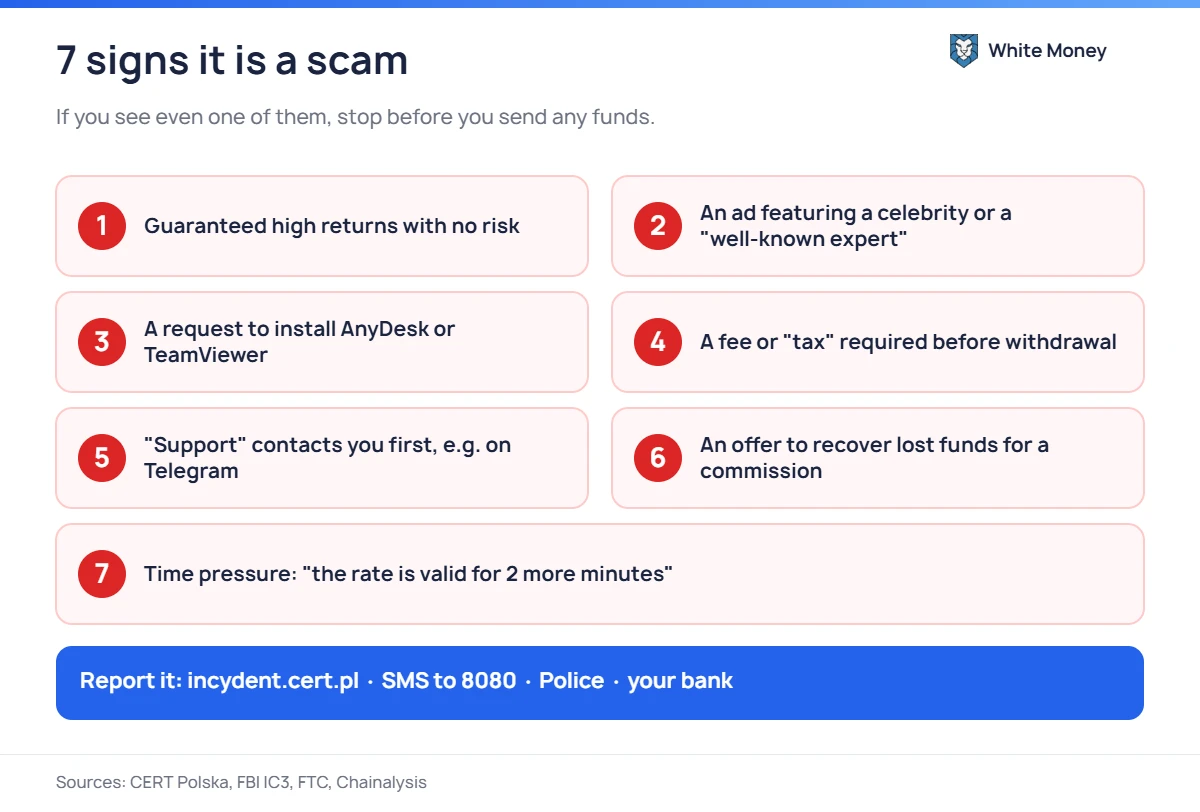
- Guaranteed high returns with no risk.
- An ad featuring a celebrity or a “well-known expert”.
- A request to install AnyDesk, TeamViewer or other remote-access software.
- A fee, tax or commission required before you can withdraw.
- “Support” that contacts you first, e.g. on Telegram.
- An offer to recover lost funds for a fee.
- Time pressure: “this rate is valid for 2 more minutes”, “today only”.
4. How to protect yourself
- Check platforms - in the ESMA register (MiCA-authorised providers), on the Polish KNF public warning list and on the CERT Polska warning list.
- Open sites from bookmarks, not from ads, sponsored search results or messages.
- Do not share your screen or install software at the request of people you met online.
- Read what you sign in your wallet; avoid unlimited token approvals and revoke them regularly.
- Check the whole recipient address and never copy it from your transaction history; for larger amounts, send a test transaction first.
- Secure your accounts with a hardware key or passkey - more in our guide how to store cryptocurrency safely.
5. What to do if you have been scammed
- Stop all contact and do not pay anything more - no “unlocking fees”.
- Secure your accounts: change passwords, log out other sessions and revoke wallet approvals; if someone had remote access, scan or wipe the device. If the scammer learned your seed phrase, move the remaining funds to a new wallet.
- Collect evidence: website addresses, chat screenshots, wallet addresses, transaction IDs (TXIDs) and payment confirmations. We show how to find a TXID in how to check a crypto transaction in a blockchain explorer.
- Call your bank if you paid by card or bank transfer, and in Poland reserve (block) your PESEL number if you shared personal data.
- Report the crime to the police - in Poland at any police station or via the Central Cybercrime Bureau’s form.
- Report the incident to CERT Polska at incydent.cert.pl and forward suspicious text messages free of charge to 8080.
- Notify the platform where the funds went - regulated providers may freeze the recipient’s account if you act quickly.
Live in another EU country? Europol maintains a page with links to each country’s cybercrime reporting channels.
6. Frequently asked questions
Can crypto be recovered after a scam?
Rarely, but sometimes - mainly when the funds quickly reach a regulated exchange that freezes the account at the request of law enforcement. That is why reporting fast matters. Never pay anyone for “guaranteed recovery”.
How can I check whether a platform is legitimate?
Look it up in the ESMA register of crypto-asset service providers and on national warning lists such as those of KNF and CERT Polska. Missing company details, terms of service and real contact options are a red flag.
Someone from “support” messaged me on Telegram. What should I do?
Do not reply or click any links. Contact support only through the official website or app, typing the address yourself.
Can simply signing a transaction in my wallet be dangerous?
Yes. A signature can give a contract the right to move your tokens. Only sign what you understand, on sites you opened yourself.
Sources
- FBI Internet Crime Complaint Center - 2025 Annual Report (PDF)
- Chainalysis - crypto scams in 2025
- Europol - IOCTA 2026
- NASK - CERT Polska 2025 report (in Polish)
- CERT Polska - fake investments (in Polish)
- CERT Polska - warning list and reporting websites (in Polish)
- KNF (Polish Financial Supervision Authority) - public warning list
- Polish Police (CBZC) - report cyber fraud (in Polish)
- FBI - warning about fund recovery scams
- FinCEN - suspected digital asset scams
- FTC - What to know about cryptocurrency scams
- Chainalysis - address poisoning
- Europol - report cybercrime online
- ESMA - MiCA and the register of crypto-asset service providers
Leave a Reply