

USDT is one “digital dollar”, but technically it is many different tokens on different blockchains. Tether currently issues it on more than a dozen networks, and when exchanging you will most often meet three: Tron (TRC-20), Ethereum (ERC-20) and BNB Smart Chain (BEP-20). They differ in fees, speed and address format, and a transfer sent on the wrong network may never reach the recipient. We explain the differences and show how not to lose your funds.
Key points
- The network you send on must be the same network the recipient supports.
- Tron addresses start with “T” and have 34 characters; Ethereum and BNB Smart Chain use the identical 0x… format (42 characters) - which is why mixing them up is so easy.
- Network fees are paid in the native coin: TRX, ETH or BNB - having USDT alone is not enough.
- Transaction finality: BNB Smart Chain about 1 s, Tron about 1 min, Ethereum about 15 min.
- Since September 2025, Tether no longer supports USDT on Omni, EOS, Algorand, Kusama and BCH SLP.
1. One coin, many networks
Blockchains cannot “see” each other. USDT on Tron is a TRC-20 token recorded on the Tron blockchain; USDT on Ethereum is a separate ERC-20 token; on BNB Smart Chain it is a BEP-20 token. All are issued by Tether and all are redeemable for dollars with the issuer, but you cannot simply “move” them from one network to another - you need an exchange or a bridge.
According to Tether’s list, USDT currently runs on Ethereum, Tron, BNB Smart Chain, Solana, TON, Avalanche, Aptos, Near, Polkadot AssetHub and Tezos, among others. Five older networks (Omni, EOS/Vaulta, Algorand, Kusama and BCH SLP) lost support on 1 September 2025: the tokens can still move between wallets, but Tether no longer issues or redeems them.
2. TRC-20, ERC-20 and BEP-20 compared
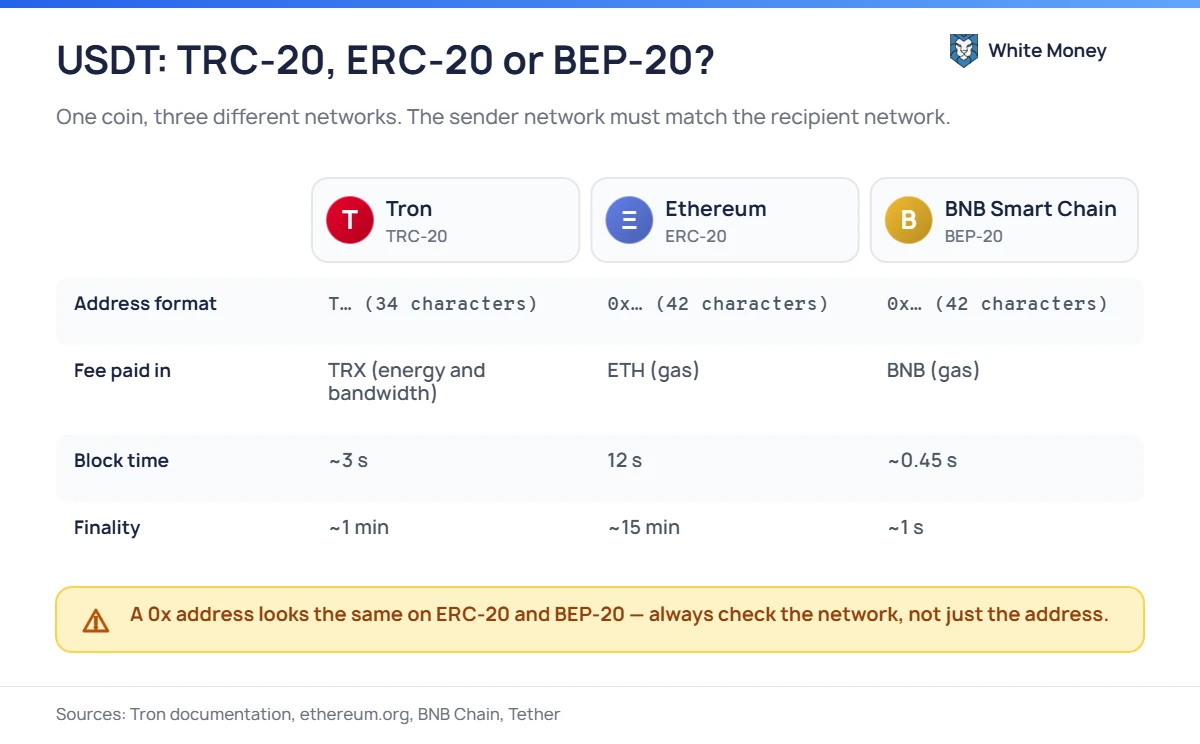
| Tron (TRC-20) | Ethereum (ERC-20) | BNB Smart Chain (BEP-20) | |
|---|---|---|---|
| Address format | T… (34 characters) | 0x… (42 characters) | 0x… (42 characters) |
| Fee paid in | TRX (Energy and Bandwidth) | ETH (gas) | BNB (gas) |
| Block time | about 3 s | 12 s | about 0.45 s |
| Finality | about 1 min | about 15 min | about 1 s |
| Typical use | transfers and exchanges | DeFi, large amounts, Ethereum apps | BNB Chain ecosystem, low fees |
3. How fees are calculated
Tron: Energy and Bandwidth
Every Tron transaction consumes Bandwidth - up to 600 units per day are free. A TRC-20 token transfer is a smart-contract call that also consumes Energy, which has no free allowance. If you have no staked TRX generating Energy, the network burns the equivalent amount of TRX from your account. The cost depends on the Energy price set by network votes - in 2025 a cut from 210 to 100 sun was proposed. A transfer to an address that has never held USDT usually costs more.
Ethereum: gas
The fee is gas used × (base fee + priority tip). The base fee is burned and rises when the network is busy. A plain ETH transfer uses 21,000 gas, and a token transfer uses more because it executes contract code. That is why USDT on ERC-20 is often the most expensive option at peak times.
BNB Smart Chain: gas in BNB
BNB Smart Chain is Ethereum-compatible (EVM) and uses the same gas model, but fees are paid in BNB and are usually low. Since the Fermi upgrade in January 2026, blocks are produced about every 0.45 seconds.
Remember the native coin. To send USDT from your own wallet, you need a little TRX, ETH or BNB for the fee. When withdrawing from an exchange or exchange service, the provider usually covers the network fee as part of its commission.
4. Speed: confirmations vs finality
A transaction is “confirmed” once it is included in a block, but only when it reaches finality is it practically impossible to reverse. On Tron, a block becomes final once 19 of the 27 Super Representatives have built on it - about a minute. On Ethereum, finality comes after two epochs, roughly 15 minutes. On BNB Smart Chain, two blocks are enough if two-thirds of validators vote. That is why exchanges require different numbers of confirmations for different networks. You can check the status and confirmations in a block explorer - we show how in how to check a crypto transaction in a blockchain explorer.
5. Common mistakes and how to avoid them
Mixing up ERC-20 and BEP-20
Ethereum and BNB Smart Chain addresses look identical, so your wallet will not warn you about choosing the wrong network. If the address belongs to your own self-hosted wallet (e.g. MetaMask), the same private key usually controls the address on both networks - just add the network to your wallet. If it is a deposit address of an exchange or exchange service that does not support that network, recovery depends entirely on the provider and is not always possible.
No coin for the fee
Got 500 USDT in a Tron wallet but 0 TRX? You cannot send it. Always keep a small reserve of the native coin.
Address poisoning
Scammers send “dust” to your address (on Tron often worth less than USD 0.01) from an address that looks confusingly similar to one you use, hoping you will copy it from your history. A Carnegie Mellon University study found 270 million such attempts on Ethereum and BNB Smart Chain between 2022 and 2024, with more than USD 83.8 million stolen. Etherscan recommends using saved contacts, hiding zero-value transfers and checking the full address.
Fake USDT tokens
Anyone can create a token called “USDT”. Only add the official contract, whose address Tether publishes for each network.
6. Which network should you choose?
The most important rule: choose the network the recipient supports and make sure the same network is selected on both sides. Only then compare costs:
- TRC-20 - a popular choice for transfers between exchanges and exchange services; fast and usually cheaper than Ethereum.
- ERC-20 - when you use apps and protocols in the Ethereum ecosystem; the most expensive when the network is busy.
- BEP-20 - low fees and the fastest finality; choose it when the recipient explicitly supports BNB Smart Chain.
Watch out with other stablecoins: Circle’s USDC is not natively issued on Tron or BNB Smart Chain, so do not assume every coin is available on every network. For more rules on exchanging safely, see how to safely exchange cryptocurrency online.
7. Frequently asked questions
Is USDT on TRC-20 and ERC-20 the same coin?
Economically yes - the same issuer and the same value. Technically they are different tokens on different blockchains that cannot be sent directly between networks.
What happens if I send USDT on the wrong network?
If the recipient wallet is self-hosted and controls the same address on both networks, the funds can usually be recovered. If it is an exchange or exchange service that does not support that network, it depends on the provider. Contact them immediately and give them the TXID.
Why do I need TRX to send USDT?
Because fees on Tron are paid in TRX (as Energy and Bandwidth). Likewise, on Ethereum you need ETH and on BNB Smart Chain you need BNB.
How many confirmations are required?
It depends on the network and the recipient’s policy. Many services credit a deposit after finality or after a set number of blocks - check the terms or the deposit form.
Sources
- Tether - supported protocols
- Tether - transition plan for legacy blockchains
- TRON Developer Hub - resource model (Energy and Bandwidth)
- TRON Developer Hub - consensus
- TRON Developer Hub - accounts and addresses
- ethereum.org - gas and fees
- ethereum.org - proof of stake
- ethereum.org - transaction finality
- BNB Chain - BNB Smart Chain documentation
- BNB Chain - Fermi hard fork (0.45-second blocks)
- Etherscan - what is address poisoning
- TRM Labs - address poisoning on Tron
- Carnegie Mellon University - study of address poisoning attacks (arXiv)
- Circle - USDC networks and contract addresses
Leave a Reply